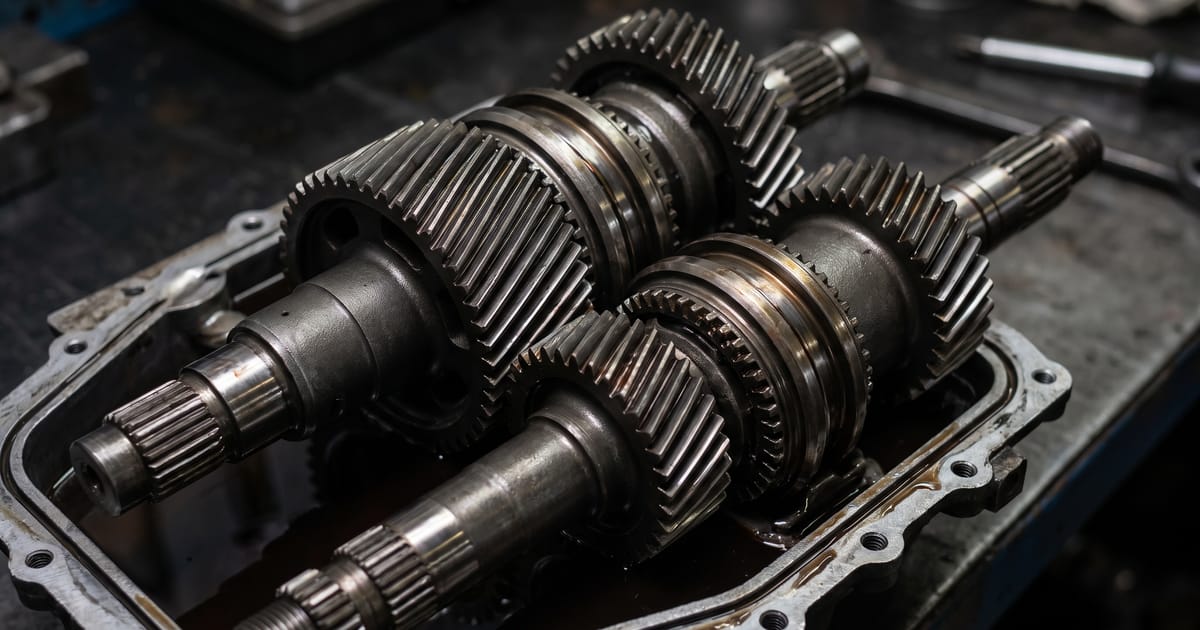
Automatic Gearbox Service: The "Sealed for Life" Myth, and What the Oil Actually Does
The truth about an automatic gearbox service, why sealed for life does not mean maintenance free, and what the oil actually does inside your box.
The workshop, Team Mercedes Cardiff
If you own an automatic, you have probably been told at some point that the gearbox is "sealed for life" and never needs attention. It is one of the most misunderstood phrases in the trade, and it quietly costs people a great deal of money.
We have been building and rebuilding German cars for nineteen years, ten of those inside a main dealer and five more at another marque's workshop. In that time we have seen the sealed for life idea do more harm than almost any other piece of received wisdom. So let us explain what is actually happening inside that box, and why a service is cheap insurance against a very expensive failure.
What "sealed for life" really means
Here is the honest version. Sealed for life does not mean the oil lasts forever. It means the manufacturer has decided not to publish a routine interval for it, usually so the car looks cheaper to run over the warranty period.
The word "life" is doing a lot of work in that phrase. It refers to the design life of the vehicle as the manufacturer sees it, not the far longer life most owners expect to get out of their car. Plenty of the autos we look after are well past the point the manufacturer ever planned for, and they are still earning their keep because someone chose to maintain the gearbox anyway.
Key takeaway: Sealed for life is a marketing position, not an engineering guarantee. The oil in an automatic gearbox degrades like any other fluid, and a planned service is a fraction of the cost of a replacement box.
What the oil actually does inside the box
People picture gearbox oil as simple lubrication, the same job engine oil does. In an automatic it does far more than that, and that is exactly why it wears out.
It transmits power
In a traditional torque converter automatic, the fluid is part of the drive itself. Power moves from the engine to the gearbox through the fluid inside the torque converter. If that fluid is tired and thin, the way it transmits that power changes, and you start to feel it.
It operates the gearbox
Modern autos are hydraulic. The fluid is pushed through a valve body, a maze of tiny passages and solenoids, to apply clutches and bands and select gears. Clean fluid at the right pressure gives you crisp, well timed shifts. Dirty fluid full of clutch material and varnish slows those passages down and makes shifts lazy, harsh or hesitant.
It cools and protects
The fluid carries heat away from the clutches and gears. Heat is the enemy of any automatic. As the oil ages it loses its ability to shed heat, which accelerates the wear on everything it touches. It is a loop that feeds itself: tired oil runs hotter, and hot oil ages faster.
It keeps clutch material in suspension
As the friction clutches inside the box wear, tiny particles come off. Fresh fluid and a healthy filter hold that debris safely in suspension and trap it. Old fluid lets it settle and circulate, where it scores surfaces and clogs the valve body.
The signs your gearbox oil is past its best
You do not need a warning light to know the fluid is tired. The box will tell you if you are paying attention.
- Shifts that feel delayed when you pull away, a pause before the drive arrives
- A jolt or thud on changes that used to be smooth
- Hunting between gears on a steady throttle, especially on a gentle incline
- Slipping, where the revs rise but the speed does not follow cleanly
- A gearbox that runs hotter than it used to, sometimes shown on the dash
Catch these early and a service often transforms how the car drives. Leave them, and you are into clutch pack wear and valve body damage, which is a different conversation entirely.
What a proper automatic gearbox service involves, and the order we do it in
A genuine service is not just draining what will fall out and topping it back up. A plain drain only removes part of the fluid, because a large amount stays trapped in the torque converter and the cooler lines. Done properly, here is the order of work.
1. Inspect and read the box first
We connect to the gearbox and check the fault memory and the live operating temperature before we touch anything. The fill level on many of these boxes is temperature dependent, so we need to know what the box is doing while it is still sealed.
2. Drop the pan and change the filter
We remove the sump pan to get at the filter. On a lot of boxes the filter and pan gasket are a single service item, and the pan itself often carries a magnet that collects metal debris. What we find on that magnet tells us a great deal about the condition of the box.
3. Replace the fluid properly
We refill with the correct specification fluid for that exact gearbox. This matters more than almost anything else. Automatics are fussy about fluid specification, and the wrong oil, even if it looks right, can cause shift faults on its own. On the boxes that warrant it, a fluid exchange moves far more of the old oil out than a basic drain ever could.
4. Set the level at the correct temperature
This is the step that gets skipped most, and it is the one that separates a real service from a bodge. The final level is set with the box at its specified temperature, not cold, not guessed. Too little or too much fluid both cause problems, so we bring it to temperature and set it to the figure the manufacturer calls for.
5. Road test and recheck
We drive the car through the full range of gears to confirm the shifts are clean and the box is holding temperature, then recheck for any faults that have appeared.
If you want to understand how this fits into the bigger picture of your car's maintenance, our guide on which service your car is actually due is a useful read: Interim, Full or Major Service.
Why the economics always favour a service
This is the part that should settle the argument. An automatic gearbox is one of the most expensive components on the whole car. A replacement box, or a full rebuild, is in a completely different league to a service.
We will not quote figures here, because every job is priced per vehicle once we have seen it. But the principle is simple and does not need a number: a service is a small, planned cost at sensible intervals, and a replacement box is a large, unplanned one. The fluid is cheap. The gearbox is not.
There is also the matter of how the car drives in the meantime. A box running on fresh fluid shifts the way it did when it was newer. That is worth something every single day you own the car, quite apart from avoiding the big bill at the end.
How often, and does it apply to every automatic
There is no single interval that covers every box, which is partly why the sealed for life label exists at all. But as a general rule of thumb, we like to see a service somewhere in the region of every 60,000 miles for most torque converter autos, and sooner for cars that tow, sit in heavy traffic or get worked hard.
Dual clutch gearboxes are a separate case with their own service needs, and we have written about those elsewhere. This post is about the traditional and modern torque converter automatics that make up most of what comes through our doors.
If your car has never had the fluid touched and it is well past 60,000 miles, do not panic, but do get it looked at. We will check the condition of the fluid and the debris on the magnet before we recommend anything, because on a very high mileage box that has never been serviced, the right advice depends on what we find.
The bottom line from our bench
Sealed for life is a phrase that benefits the manufacturer more than the owner. The oil does a harder job in an automatic than in almost any other part of the car, and it wears out doing it. Looking after it is one of the cheapest things you can do to protect one of the most expensive parts you own.
If your automatic has started shifting differently, or you simply do not know when the fluid was last changed, bring the car to us at Cardiff Marine Village and we will check it over and tell you honestly where it stands. You can see more about how we approach servicing on our car servicing page.
To book, get in touch or call us on 07496 265651. We will take a proper look and give you a straight answer.